Economics
Sharing Your Data Comes at a Cost—and Not Just to You
A new study co-authored by Yale SOM’s Jidong Zhou models the interaction between individual privacy choices and firms’ strategic responses and finds that data sharing can impose costs on other consumers—including those who opt out.

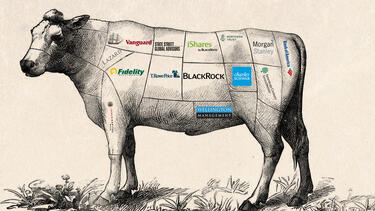
What Happens When the Same Investors Own Everything?
Diversification means that in many industries, companies are owned by an overlapping set of investors, reducing their incentive to compete.
How Do You Enforce Antitrust Law in a Global Marketplace?
Professor Fiona Scott Morton, the former chief economist in the Antitrust Division of the U.S. Department of Justice, on the state of global competition law.

Why Is Healthcare So Expensive?
Yale’s Zack Cooper discusses new findings on what drives the high costs of healthcare and how to rein them in.

What’s the Price of Love?
Choosing a mate is a calculation that the benefits of further search are outweighed by the costs, says Paul Oyer ’89.
Can Cross-Sectoral Collaboration Reverse the Trend toward Income Inequality?
Income and wealth inequality in the U.S. has become a topic of widespread concern and discussion. A recent panel of Yale SOM alumnae posited that action from the federal government is unlikely. But the panelists found reason for hope in examples of the public, private, and nonprofit sectors collaborating to address the nation’s wealth gap.

What Will Climate Change Do to the Economy?
Modeling the economic consequences of climate change is difficult, uncertain work. In addition, any result is sure to be subjected to political attack. For decades, Yale's William Nordhaus has been developing models that can inform policy decisions.

What Does the Future of the European Union Look Like from Spain?
Former Spanish prime minister José Luis Rodríguez Zapatero discusses Spain’s long, difficult recovery from the global economic crisis and the lessons of the crisis for the future of the European Union.
Firms’ Shared Ties Hurt Merger Performance
Merger performance varies greatly depending on the number of pre-merger third-party ties connecting the acquiring firm to its partner, according to a new study by researchers at the Yale School of Management and INSEAD.
Is antitrust law keeping up?
Can laws created to rein in the monopolies of the industrial age still work in the information age? After spending a year as the top antitrust economist at the U.S. Department of Justice, Professor Fiona Scott Morton describes the state of antitrust regulation today.
What has happened to the labor market in the Great Recession?
With 14 million people out of work in the U.S., labor markets are receiving a lot of attention. Yale SOM's Lisa Kahn did groundbreaking work on the impact of graduating into a bad economy. She offers her take on what's happening now and what to expect.


