Economic Development
When Essential Infrastructure Projects Involve Exceptional Risk, No Sector Can Go It Alone
At the World Bank’s Multilateral Investment Guarantee Agency, Laura Alonzo ’96 mobilizes private investment in the developing and conflict-wracked economies that need it most.


Can Insurance Help the Poor Manage Risk?
Rainfall insurance can help a farmer survive a drought year and ultimately increase prosperity in rural areas. So why aren’t more using it? Many people in developing countries rely on informal insurance, such as a family network, rather than formal insurance. Yale SOM professor Mushfiq Mobarak’s research has tested the effects of formal insurance for farmers in India and elucidated how the two systems interact.

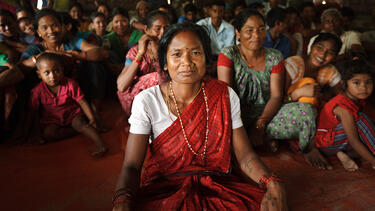
Can Teaching Tea Workers In India To Read Have a Larger Impact?
Mercy Corps’ literacy program in Assam, India, works because it is local—designed and taught by staff with an understanding of the culture there. As a global organization, Mercy Corps needs to balance investment in a deep understanding of local issues with the imperative to make a difference in as many lives as possible.

Do international development organizations need to be in the innovation business?
Neal Keny-Guyer '82, CEO of Mercy Corps, talks about his organization's formula for innovation: local leadership, rigorous metrics, and a willingness to adapt and change in mid-project.
Can local empowerment create lasting change?
Over the last 50 years, Western aid to the poorest countries has often failed to make tangible improvements in the lives of their citizens. Nadim Matta '89, president of the Rapid Results Institute, talks about the organization's approach to achieving incremental change by empowering frontline stakeholders.

Can diplomacy benefit business?
The days of U.S. boycotts of South Africa are long gone. The country is an economic powerhouse in Africa and a key economic partner for the U.S. In four years as U.S. ambassador to South Africa, Donald Gips ’89 worked to increase investment and trade flows between the countries.
What are the realities of microfinance?
New research is debunking myths about microfinance and showing how organizations can effectively address problems associated with poverty. Yale faculty Dean Karlan, Tony Sheldon, and Rodrigo Canales discuss the problems and the promise in the field of microfinance and the lessons for other kinds of social enterprise.
Can we end poverty?
Esther Duflo, a development economist at MIT and director of the Abdul Latif Jameel Poverty Action Lab, explains how our understanding of the economic lives of the poor has grown more complex in recent years. While Duflo doesn't see any silver bullet that will end poverty, she points to progress, in part from the use of randomized control trials to solve specific problems.
Can coffee help juice economic development?
A nonprofit is teaching business skills to East African farmers in order to let them enter the high-profit global market for specialty coffee. The project showed enough promise to get $50 million in underwriting from the Gates Foundation, and now aims to reach 180,000 growers. David Browning ’99 of Technoserve describes how to educate small-hold farmers to plug into the global market.
Where does Africa fit in the globalization puzzle?
The continent has often been singled out as an exception to the story of increasing globalization. Todd Moss, an Africa expert with the Center for Global Development, discusses Africa’s integration in world markets, why trade between African countries is so hard, and the role of outside powers such as China.
Has globalization failed in Nigeria?
Oil pumped from the Niger Delta is loaded on supertankers and shipped into the global market, accounting for 3% of world production and generating substantial revenues for the Nigerian government. What has this connection to the world economy done for Nigeria?


