AI
Who Trains Junior Employees in the Age of AI?
AI is best at exactly the entry-level work that used to turn novices into experts. Professor K. Sudhir writes that organizations will need to find new ways to build the skills and judgment that junior employees once developed by doing those tasks themselves.

For Companies Eyeing AI, the Question Is ‘When, Not If’
Generative AI may well be transformative, but firms will need to make judgments on whether the costs, challenges, and risks of being a first mover makes sense.

Can AI Help Design a More Appealing Car?
Designing a new car is expensive, time-consuming, and risky. In a new study, Yale SOM’s Alex Burnap shows how machine learning can identify promising models and help designers generate new designs.

Putting AI on Every Team
Is artificial intelligence ready to become a standard business tool? McKinsey’s Bryce Hall ’12 says that combining human expertise and judgment with AI’s data-driven recommendations is a challenging but powerful way to deliver business results.

Can AI Make Economic Predictions by Reading the Newspaper?
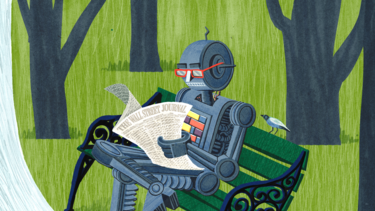
In a new study, a team led by Yale SOM researchers devised a way to distill the text of the Wall Street Journal into numerical indicators, which could help policymakers predict how the business cycle will unfold over the coming months and years.
Is Elon Musk Right about the Bot Problem on Twitter?
Elon Musk’s attempt to buy Twitter has turned into a battle over the prevalence of bot accounts on the platform. We asked Prof. Tauhid Zaman, who has studied the impact of bots, how much they skew the experience of Twitter users.

To Shift Opinions in Online Conversations, Start by Building Trust
New research from Yale SOM’s Tauhid Zaman suggests that starting by establishing common ground makes it possible to make connections and even change some minds.

Now It’s Personal: How Knowing an Ad Is Targeted Changes Its Impact
A consumer’s knowledge that an advertisement has been tailored to their interests changes how they respond, according to a new study co-authored by Yale SOM’s Jiwoong Shin. Firms evaluating marketing strategies should factor consumers’ inferences about targeted ads into their advertising decisions, Shin says.

Can We Protect Our Election from the Bots?
More than 50,000 Russia-linked bots were active on Twitter during the 2016 election. Are they back? We talked with Prof. Tauhid Zaman, who has carried out a series of studies identifying bot networks and assessing their impact.

Machine Learning Model Extracts Insights from Customer Reviews
A new study co-authored by Yale SOM’s K. Sudhir uses natural-language analysis to learn from what customers are saying—and to infer meaning from what remains unsaid.

Online and Off, We Are Drawn Toward Those with Similar Writing Styles
Both online and in-person friendships are more likely to develop between people who have similar linguistic styles, according to a new study co-authored by Balázs Kovács at Yale SOM.